Recent Posts

































Why Cattle Are Considered Sacred in Hinduism: Historical reason

6ft79V
No.2006
The midwit take on the "Sacred Cow" usually falls into two categories:
>They’re just vegetarians cucks
>It’s an backward agrarian superstition
Both are filtered. To understand the Aghanya (the Unslayable) doctrine, you have to look at the Early Vedic Period not as a religion, but as a resource management system.
The Vedic religion is the purest extant structure of the Proto-Indo-European faith. In the earliest layers of the Rigveda, which were written before arrival to Indian subcontinet, the bovine was the primary unit of sacrifice. They were a prestige economy offering the most valuable asset (cattle) to the natural elements Agni (Fire), Indra (Storm), and Varuna (Ṛta/Cosmic Order).
As the Vedic tribes migrated from the steppe into the Indian subcontinent, the scarcity of cattle relative to the density of the aborginal population forced a theological pivot. There were few factors that defined the scardeness of cow for years to come.
The Indo-Aryan expansion into the subcontinent was a biological conquest. The Aryas arrived with (LCT) mutation, giving them massive advantage over aborginals.
The expansion was underpinned by Lactose Persistence. While the aboriginal populations of the subcontinent largely viewed cattle as a primary meat source, the Vedic tribes understood the animal as a Continuous Yield Asset.
The Vedic Arbitrage- The tribes understood the cow as a self-replicating, high-yield creature. By keeping the animal alive, they converted inedible cellulose into a perpetual stream of protein and fats (milk/ghee).
Killing a cow for a single meal was seen as a civilizational IQ test that the abbos were failing. Killing the cow became an act of civilizational sabotage; the prohibition was for protecting the Vedic resource base from both internal mismanagement and external meat-focused locals who lacked the genetics to utilize dairy. In short, the Vedic tribes protected their primary assets from being poached or consumed by those who didn't understand its long-term value.
The Derivative Economy- The ritual shifted from the physical animal to the derivative of the animal, Ghee. Because Agni required ghee to function as the conduit between the human and the divine, the cow became the physical substrate of the Rta (Cosmic Order). tho kill a cow was to sever the communication link between the human realm and the Rta (Cosmic Order).
The Indo-European root of the Vedic religion are purely pastoral. In the Rigveda, wealth isn't measured in gold, it was measured in Gavyuti. The word for "war", Gaviṣṭi, literally translates to the desire for more cows. While the Western Indo-European branches (Norse, Hellenic, Celtic) eventually secularized and moved toward a "meat-and-grain" model, the Vedic structure doubled down on the Pastoralist Ideal. They realized that in the specific ecological niche of India, the cow was more valuable as a draft animal and a dairy source than as a carcass. The "Sacred" status is simply the Theologization of Utility.
In today's world, the Hindu "Sacred Cow" law is based on the rules given by its pastoral founders. Maybe they are not true for today's world, as domesticating cow is quite simple and cow is not scarce either, but cattle was the most efficient piece of technology in the Bronze Age, and preserving it is the oldest and most successful instance of Institutionalized Long-Termism. It is the transformation of a biological asset into a metaphysical icon to ensure its survival against the high time preference of the masses.
So in short Aryans protected the cow because they were the only ones high-IQ enough to realize it was a perpetual motion machine for civilization.


utdr6k
No.2007
>>2006(OP)
Full sappot, but since you're a dalliwala, its minus points to your argument


OVlU4a
No.2008
>>2006(OP)
Complete nonsense thread
Vegetarianism is deeply linked with the belief in
1. soul
2. rebirth
Which arose around 1000-1500 BCE
But seems to be a AI slop thread anyway
OVlU4a
No.2009

Bugmen
> NOOO COWS ARE HIGH YIELD
> DONT KILL THEM!!
Aryans
> these animals have souls just like humans
> they are not objects
> if you harm them we will kill you
I can tell you are abrahamic just by the way you view animals.
9NcE9h
No.2010
>>2008
Vegetarianism is a buddhist/jain concept , vedic hinduism was highly sacrifical which doesnt makes sense if it promoted vegetarianism
OVlU4a
No.2011
>>2010
> Veg is buddhism jain
No it's not.
It arose 1000-1500 BCE together with the brahmanas when reincarnation was conceptualized.
Jainism and Buddhism are much younger than that , by around 1000-500 years.
Also Sacrifice doesn't mean what you think it does. A sacrifice means losing something important to you.
It's not a small gesture. An animal being sacrificed is still compatible with being vegetarian.
The importance of sacrifices come from the fact that whoever makes the sacrifice is hurting himself earnestly.
Viewing animals as objects is entirely abrahamic coded, it's how Muslims, Xtians, Jews and also bug cultures argue.
woXRAx
No.2012
>>2010
Vedic Hinduism is a little here and there, it is fair on both concepts eating meat as well as trying to abstain from it when you can. Historically it is very much normal for people to abstain from meat even in vedik era, specially for the hotra clans. However remaining varnas had a little bit more freedom in eating meat. The hard line was aghinya status of cows though. That is why you see vegetarian sects like smartha and vaishnav but also see more meat oriented ones like sakta and Shaiva. A deep study also shows ritual meat is consumed during specific times, majority will still refrain from it time to time. I guess it is all about balance.
woXRAx
No.2013
>>2007
KEK

ZPUNux
No.2014
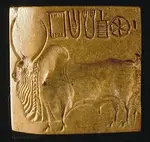
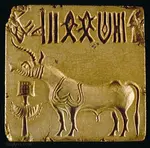
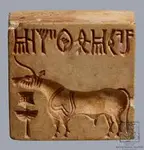
Entire logic is faulty considering IVC was not really aboriginal populated it may have outskirts. IVC was just one urbanized cluster or living cluster compared to the rest of the india as visible from the archeological data.
Another thing is that the the cattle, farming culture was exchanged in zagros, ivc was already taking care of cattle and it was pretty clear that zagrosian cultures as a whole considered bulls as sacred.
If i am not wrong, even indra is compared as one in terms of strength. It's more likely that due to the environment changes and fall of ivc and surrounding region, drought etc. made cows even more valuable just from material point of view. But culturally the cattles cows, bulls were sacred even for ivc region.
ZPUNux
No.2015
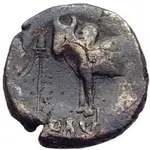

>>2014
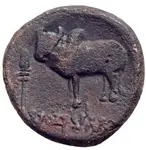
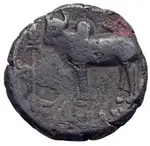
Those were ivc seals and picrel are coins from Ayodhya. The frame nearby the bull is none other than yupa. Required for sacrifice etc.
bvgX01
No.2016
>>2014
That's actually a pretty solid point
ZPUNux
No.2017
in fact bull worship is heavily correlated with the chg/neolithic iranian ancestry and likely as evident from seals etc. they were sacred, may have been sacrificed as a sign of highest form of well 'sacrifice' and likely cows were equally sacred.
OVlU4a
No.2018
ZPUNux
No.2019
>>2018
calling them iranian itself is misnomer but let's keep the term as it is for the sake of understanding.
yes there's a theory about LGM and how places suitable for living around that time were coastal areas including that of india. there's a likelihood of back and forth of the population from there.