
Recent Posts
















































Xes2tN
No.463478
Xes2tN
No.463500
Land owner wins again:
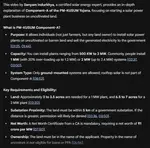
This video by Sanyam Indurkhya, a certified solar energy expert, provides an in-depth explanation of Component-A of the PM-KUSUM Yojana, focusing on starting a solar power plant business on uncultivated land.
What is PM-KUSUM Component-A?
Purpose: It allows individuals (not just farmers, but any land owner) to install solar power plants on uncultivated or barren land and sell the generated electricity to the government [01:25, 01:44].
Capacity: You can install plants ranging from 500 KW to 2 MW. Commonly, people install 1 MW (with 20% over-loading up to 1.2 MW) or 2 MW (up to 2.4 MW) systems [02:37, 03:00].
System Type: Only ground-mounted systems are allowed; rooftop solar is not part of Component-A [08:52].
Key Requirements and Eligibility:
Land: Approximately 3 to 3.5 acres are needed for a 1 MW plant, and 6.5 to 7 acres for a 2 MW plant [03:20].
Substation Proximity: The land must be within 5 km of a government substation. If the distance is greater, permission will likely be denied [03:36, 03:50].
Net Worth: A Net Worth Certificate from a CA is mandatory, requiring a net worth of ₹1 crore per MW [07:50].
Ownership: The land must be in the name of the applicant. Property in the name of ancestors is not eligible for loans or PPA [06:56].
Financial Details:
Power Purchase Agreement (PPA): The government signs a fixed PPA for 25 years at a rate of approximately ₹3.25 per unit [04:16, 05:04].
Loans: The government facilitates loans for 80–85% of the project cost at an interest rate of 9% to 10.5% for a 15-year period, subject to credit rating and bank approval [07:12, 07:33].
Subsidies: Unlike other components, there is no government subsidy for Component-A. However, this allows the use of Non-DCR panels (imported cells), which can be ₹10–12 cheaper per watt than domestic cells [08:59, 09:40].
Application Fees: A fee of ₹5,900 per MW is required during the application process [08:20].
Application Process:
Applications are not open year-round; they are released via tenders on the websites of state nodal agencies (e.g., Urja Vikas Nigam).
The process follows a "First Come, First Served" basis. Once the designated capacity of a substation is reached, no further applications are approved [05:32, 05:52].
Xes2tN
No.463519
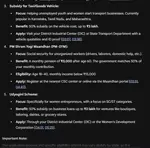
This video from DIGITAL PATHSHALA provides a comprehensive guide on the Prime Minister's Employment Generation Programme (PMEGP) loan scheme for starting new businesses in India.
PMEGP Scheme Overview:
Objective: To generate employment by providing loans for new manufacturing or service-oriented ventures [01:28].
Maximum Loan Amount:
Manufacturing Sector: Up to ₹50 lakh.
Service Sector: Up to ₹20 lakh [01:52].
Subsidy Percentage (Based on Category & Location):
General Category: 15% (Urban) or 25% (Rural). Self-contribution: 10%.
Special Category (SC, ST, OBC, Minorities, Women, Ex-Army): 25% (Urban) or 35% (Rural). Self-contribution: 5% [03:02, 04:03].
Subsidy Lock-in: The subsidy amount is frozen in a separate account for 3 years, after which it is adjusted against the loan [04:56].
Eligibility and Requirements:
Applicant: Must be an Indian citizen, at least 18 years old, and not a previous beneficiary of any government subsidy scheme [06:00, 06:16].
Educational Qualification: For projects above ₹10 lakh (Manufacturing) or ₹5 lakh (Service), the applicant must have passed at least 8th standard [07:04].
Creditworthiness: A good CIBIL score is required; defaulters are ineligible [06:07].
Priority: Applicants who have received training from government institutes or hold an EDP (Entrepreneurship Development Programme) certificate are given preference [06:21, 06:41].
Mandatory Documents:
Aadhar Card (linked to mobile number) and ID proof (Voter ID, DL, etc.) [06:51].
Residence proof and 8th-standard pass certificate [07:01, 07:04].
Business Project Report (prepared by an authorized CA) [07:09].
Land documents (registry or lease agreement) and bank statement for the last 6 months [07:25, 07:35].
Category/(indian) certificate (if applying under the Special Category) [07:20].
How to Apply (Online Only):
Visit www.janusamarth.in to check eligibility and get an estimate of your potential loan and subsidy [08:16].
The site will redirect you to the official PMEGP portal: www.kviconline.gov.in [08:39].
Fill in the detailed application form, attach required documents, and submit [08:51].
Important Note: The PMEGP scheme is only for new businesses; existing businesses should look into other schemes like Pradhan Mantri Mudra Yojana [05:05].
Watch the full step-by-step guide here: PMEGP Loan and Subsidy 2025/2026
>Special Category (SC, ST, OBC, Minorities, Women, Ex-Army): 25% (Urban) or 35% (Rural). Self-contribution: 5% [03:02, 04:03].
No wonder so many muslims have some manufacturing plant